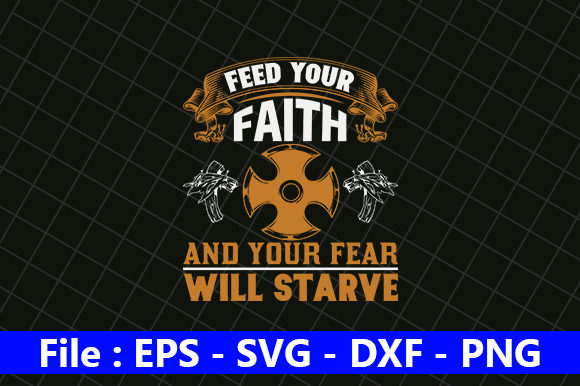
Feed Your Faith and Your Fear Will Starve
Every creative project, business decision, or career move eventually reduces to a contest for your mental real estate. Competing for space are two forces: faith in your ability to figure things out, and fear of what might go wrong. The phrase Feed Your Faith and Your Fear Will Starve captures a practical truth about psychology and resource allocation. It does not ask you to eliminate fear—fear provides useful signals. Instead, it asks you to become the conscious curator of what grows in your mind. When you deliberately invest energy in preparation, action, and trust, fear, lacking its primary nutrient of attention, naturally withers.
This reframes the problem entirely. It is not a lack of talent, luck, or opportunity that holds most creators back. It is a misallocation of focus. And because focus is something you can control, this principle gives you an immediate lever to pull.
The Mechanism Behind the Metaphor
This idea is more than motivational writing. It is grounded in how the brain works. Your prefrontal cortex handles complex, goal-directed thinking. The amygdala processes threats and triggers anxiety. These systems compete for dominance. When you engage in concrete actions—drafting an outline, learning a tool, sending an email—you activate the prefrontal cortex and displace the amygdala-driven loop of worry. Feeding faith is an operational strategy, not a vague hope.
Fear often masquerades as productivity. Endless research, meticulous planning, and waiting for the perfect moment feel like work. But they are often fear wearing a disguise. Genuine faith work is messier. It involves releasing something unfinished, asking a potential customer a question you do not know the answer to, or publishing a post that might not land perfectly. Faith feeds on evidence and action. Fear feeds on abstraction and avoidance.
The goal is not to feel fearless. The goal is to build evidence for your capability faster than your imagination builds catastrophic scenarios. Each small proof point—a positive reaction, a solved problem, a completed task—is a meal for your faith.
For Designers and Creators
The most common trap in creative work is infinite refinement. Tweaking a layout or color palette for hours beyond what is necessary rarely improves the outcome. It feeds the fear that the work is not good enough. Feeding faith means setting a hard deadline, presenting the work to a real user, and learning from actual interaction. The gap between what you imagine others will think and what they actually think is almost always smaller than you expect. Closing that gap early starves the fear of judgment.
Consider a UX designer redesigning a checkout flow. The faith-driven approach is to build a rough prototype and test it with three users in the first week. The fear-driven approach is to spend three weeks perfecting a high-fidelity mockup before showing anyone. The first path provides real data that strengthens confidence. The second path leaves you defenseless against surprises because you have been operating in a vacuum.
For Entrepreneurs and Small Business Owners
Market uncertainty is a constant, but how you relate to it makes the difference. Obsessing over a competitor's funding round or a minor shift in search algorithms is feeding fear. These factors exist outside your control. Faith is fed by deepening your understanding of your actual customers. Conduct an interview. Solve a specific pain point you have heard repeated. Publish a case study. These actions produce tangible assets that reduce uncertainty.
A common trap for founders is treating market research as a form of procrastination. Reading reports, analyzing trends, and running models can feel productive. Much of it is avoidance fueled by the fear of making the wrong move. Faith is fed by launching a minimum viable offer and gathering real revenue data. A flawed launch provides concrete feedback. A perfect plan provides only the illusion of safety.
For Marketers and Content Creators
Content anxiety often stems from chasing metrics you cannot directly control—views, shares, conversion rates. This is fear work. Faith work involves focusing on a single reader or viewer. Ask yourself: Did this piece of content help the one person who needed it most? Did it answer a specific question? Did it save them time or reduce their frustration? When you optimize for a specific person, the work becomes clearer and the anxiety around performance recedes.
A blogger worrying about algorithm changes is feeding fear. A blogger who studies their email replies and adapts their topics to the questions people actually ask is feeding faith. The second path builds an audience that trusts you. The first path leaves you chasing a platform you cannot own.
Adapting the Principle to Different Goals and Contexts
The Feed Your Faith and Your Fear Will Starve framework scales across mediums, audiences, and personal goals. Here is how different professionals can apply it directly:
- Educators: Fear focuses on test scores, curriculum compliance, and standardized outcomes. Faith focuses on the spark of curiosity in a single student. Creating one lesson that encourages a question rather than an answer feeds faith.
- Freelancers: Fear of a dry spell leads to underpricing and over-accepting unsuitable projects. Faith is fed by investing time in a specific portfolio piece that justifies a premium rate, even if it means a slow month.
- Hobbyists and Side-Project Builders: Fear compares your beginner work to a master's finished work. Faith celebrates the process. Feeding faith means sharing a work-in-progress update, focusing on the joy of learning a new technique rather than the pressure of the final result.
- Publishers and Newsletter Writers: Fear chases viral topics and broad appeal. Faith invests in a unique editorial voice and a loyal, niche audience. A consistent, personal weekly letter that serves a small engaged group is a faith asset that compounds over time.
The principle also adapts to different formats. For a podcast episode, you could structure the narrative around Feed Your Faith and Your Fear Will Starve, alternating between an honest admission of a fear and the concrete action taken to counter it. For a social media post, you might share a side-by-side: "What fear told me to do this week" versus "What faith led me to do instead." The honest contrast resonates more deeply than a purely polished success story.
Keeping the Practice Clear and Effective
Any useful idea loses power without a routine. To maintain consistency with this framework, build simple structures into your workflow.
- Audit your inputs. Review the accounts, newsletters, and voices you consume regularly. Unfollow anything that triggers comparison or inadequacy. Subscribe to sources that provide actionable frameworks and honest accounts of building. Your attention is the food you are distributing. Guard it carefully.
- Set fear boundaries. Allow yourself a short, timed session to worry constructively. Write down the worst-case scenario and a quick mitigation plan. Fifteen minutes is enough. When the timer ends, physically move to a task that builds evidence for your capability. A shift in environment—even standing up or moving to a different desk—helps break the mental loop.
- Define a daily faith win. Every morning, choose one small action that qualifies as feeding faith. Sending a cold email. Writing a hundred words. Publishing a draft. Recording a short video. The task must be concrete and completable. At the end of the day, acknowledge it. This is not about grand achievements. It is about depositing regular evidence into your confidence account.
Keeping results clear also means knowing what to stop doing. If an activity leaves you feeling drained, anxious, or stuck in a loop of comparison, it is likely feeding fear. Put a limit on it. A marketer might schedule a single fifteen-minute block for analytics review per day instead of checking the dashboard hourly. A designer might limit revision cycles to two before seeking external feedback. These constraints force faith-based action because they remove the safety net of endless polishing.
Creative Variations and Project Ideas
If you want to embed the principle into a tangible project, consider these approaches.
The Physical Faith Board
Create a physical or digital board with two sections. One side is labeled "Fear Feed" and has strict space limits—perhaps a sticky note that can be discarded when the concern is addressed. The other side is "Faith Feed" and contains evidence of progress: positive feedback, completed tasks, screenshots of growth, notes from customers. The physical act of moving a worry out of the limited space forces you to either act on it or release it.
A Faith-Based Launch Plan
Redesign a product or content launch around this principle. List every task involved. Categorize each as either faith work or fear work. Fear work includes competitor analysis, risk assessment, and over-engineering assets that nobody has asked for. Timebox these strictly. Faith work includes customer interviews, value proposition testing, and shipping a core version early. Allocate your best energy to the faith tasks. The launch itself becomes an experiment rather than a final exam.
A Content Series on Choosing Focus
Create a short series—five posts, a podcast mini-season, or a newsletter thread—titled "What I'm Choosing to Feed." Each installment addresses a specific fear that surfaced that week and the deliberate action taken to feed faith instead. This frame normalizes the internal struggle for your audience and provides you with a regular accountability structure. The vulnerability in naming the fear openly builds trust, while the demonstrated action provides genuine value.
The ultimate utility of Feed Your Faith and Your Fear Will Starve lies in its simplicity. It strips away the complexity of motivation, talent, and luck, and centers the one variable you always control: where you place your attention. Fear will never fully disappear. It evolved to protect you. But you can refuse to host it indefinitely. Every time you choose a small, brave action over a long, safe deliberation, you withdraw nourishment from doubt and give it to the work that actually matters.